
Lake Havasu City Previous Resident Eras
Lake Havasu City address history has a sharp local divide. The community was planned and marketed in 1963 and 1964, then incorporated in 1978. County land records can reach behind the city government, but the public Recorder index begins in 1988. The first two dozen years of local development therefore require older index books, microfilm, newspaper evidence, and repository work. The sources below do not all name residents. Together, they show which years can support ownership, building, or household conclusions.
| Source | Years it covers | Where held | What it shows |
|---|---|---|---|
| Recorded deed index | 1988 to present online; earlier books exist | Mohave County Recorder, EagleWeb, counter, phone, or mail | Grantors, grantees, dates, instruments, and some legal or parcel data |
| Assessor and GIS | Current; online historical depth not stated | Mohave County property search and Public Map Viewer | Current owner, situs, mail address, APN, legal text, shape, and adjacency |
| City permit reports | Combined 2010-2022; monthly 2023-July 2026 | Lake Havasu City permit archive | Permit and CO dates, full address, APN, work, contractor, and status |
| Telephone or reverse books | Local years not verified online | State inventory, library, or archive after confirmation | A listed subscriber or address entry when the volume supports it |
| Lake Havasu City Herald | 1964-1994 cataloged | Library of Congress holding record and checked repositories | Ads, notices, obituaries, businesses, and address context |
| Wills and probate | Wills 1888-1950; index to 1990, plus court files | FamilySearch catalog, Clerk of Superior Court, and possible archive transfers | Decedents, heirs, estates, and property links |
Begin with the date of interest. For a recent change, use parcel, deed, and permit records. For an early Lake Havasu City household, expect an offline handoff. Open census schedules through 1950 predate the city itself, so they trace an early newcomer in the place where that person lived before arriving.
Begin Lake Havasu City Address Records
Start from today's parcel, not the street name alone. Save the APN, assessed owner, situs address, owner mailing address, subdivision, lot, block, legal description, and any deed reference shown by the Mohave County Assessor. Situs means the physical site. The mailing field is where the tax notice goes, so it may point to a post office box, an entity, or another city. Neither field proves who sleeps at the address.
Open the same APN in GIS to confirm the shape and location. Parcel boundaries, streets, aerials, and planning layers can explain a lot split or odd access. GIS may lag a recent split by about a month and is not a legal survey or title source. This first pass gives the previous-residents search a stable land identity before changing names and dates enter the chain.
The current parcel workflow is covered in greater detail on the Lake Havasu City street directory, while address history keeps its focus on moving backward through one site.
Trace Lake Havasu City Deed Records
A deed chain follows titled ownership, not every past resident. Search the current owner as a grantee near the purchase date. In deed language, the grantee receives the interest and the grantor gives it. Record the party roles, recording date, fee number or book and page, legal description, APN when present, and image or copy route. Then search that grantor as an earlier grantee. Repeat while the land description remains consistent.
- Copy the current owner, APN, and legal description from the Assessor parcel card.
- Enter the owner's name last name first, with no comma, in EagleWeb and add an approximate date when possible.
- Open or order the acquisition deed, then identify the prior owner in the grantor field.
- Search that prior owner as a grantee and compare the legal text, not just the street address.
- At the 1988 online boundary, contact the Recorder for older books, indexes, or microfilm and continue the same role-based method.
- Grantor and grantee
- The party giving an interest and the party receiving it in a recorded instrument.
- Chain of title
- The linked sequence of transfers for the same land.
- Legal description
- The formal land description that stays useful when an address is absent, informal, or changed.
- APN
- The assessor parcel number used to connect the parcel card, map, permits, and many deed references.
The Mohave Recorded Document Search displays the official disclaimer and entry route for this work.
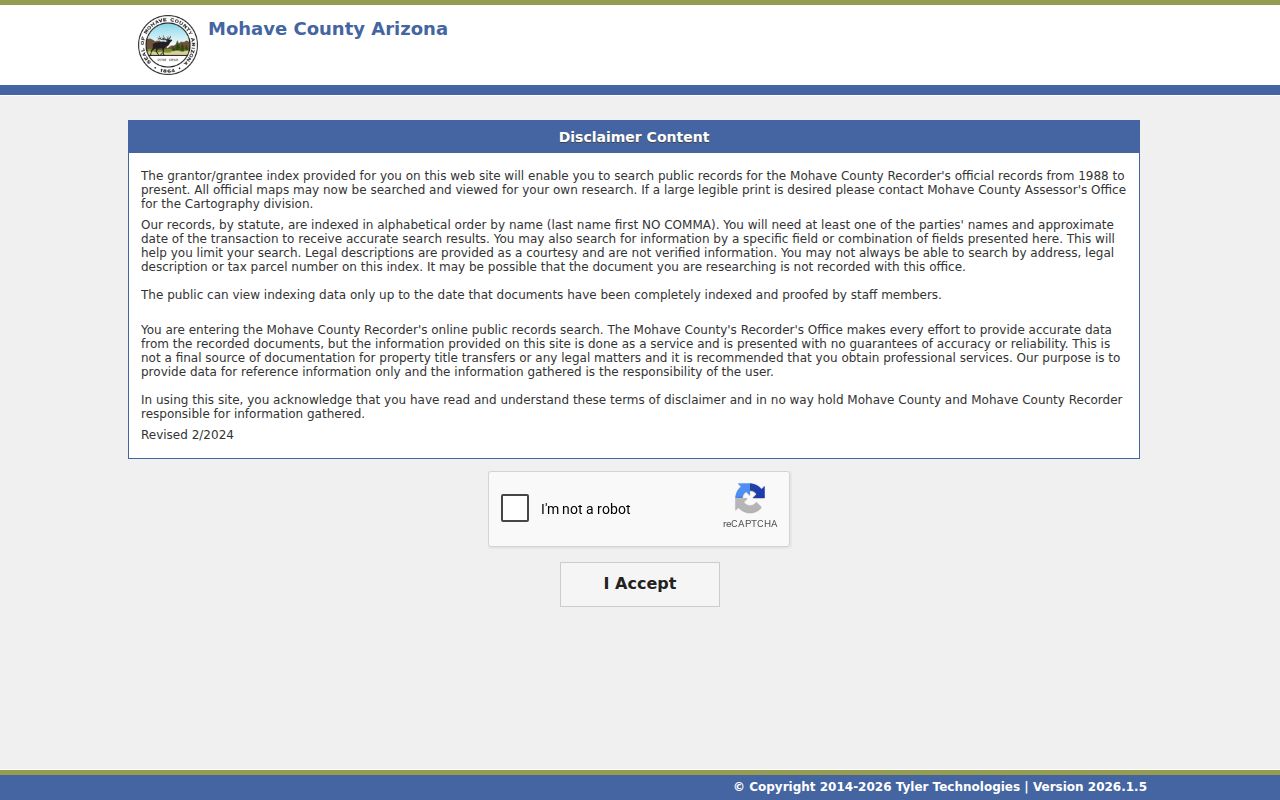
The screen marks where the online chain begins, while a missing match still calls for better name, date, or offline checks.
Cross Lake Havasu City Record Gap
Recorder EagleWeb covers 1988 to the present. That cutoff excludes about 24 years between the planned community's start and the web index. It is an access gap, not a proven record gap. The Recorder's Lake Havasu counter at 2001 College Drive, Suite 93, is open from 8 a.m. to 5 p.m. and closes from noon to 1 p.m. Searchers can also call (928) 453-0702 extension 3021 or mail a focused copy request to the main Kingman office.
The county accepts a book and page, fee number, date, or names to identify a copy. Standard copies cost $1 per page and certification costs $3 per document. Address, parcel, and courtesy legal fields do not appear on every older instrument, so name roles and approximate dates still matter. The Recorder's official office and records page sets out those channels.
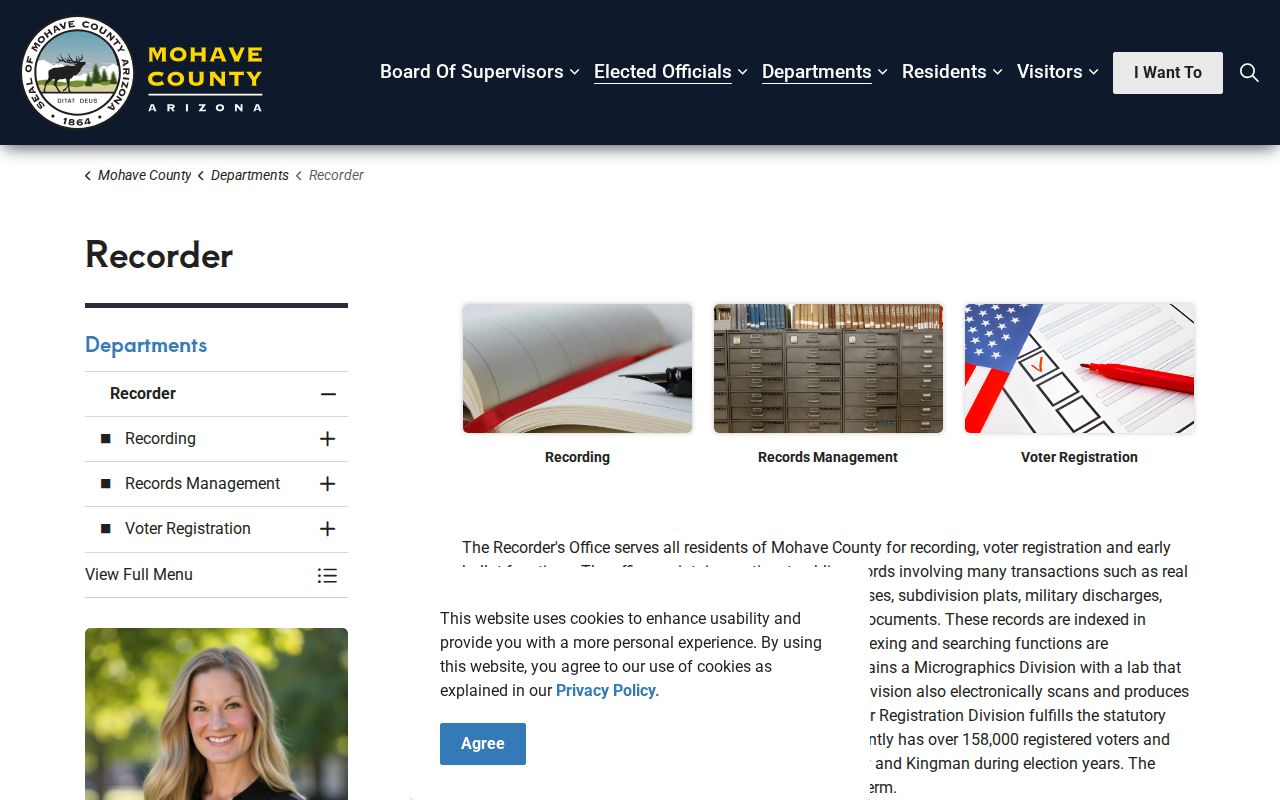
The local counter makes this early Lake Havasu City handoff possible without treating Kingman as the only path.
Insider tip. Bring the APN and legal description to the College Drive counter; street text alone may not retrieve an early instrument.
Date Lake Havasu City Address Records
Permits give a second timeline. The city's static archive combines annual reports from 2010 through 2022 and posts monthly reports from 2023 through July 2026. A January 2026 report demonstrates type, subtype, entered and issued dates, permit number, full address and ZIP, cost, contractor, APN, and status. Certificate-of-occupancy reports add the CO date and location. These dates can show when a building, addition, or approved use changed, but the contractor and permit contact are not automatically previous residents.
Pair each milestone with the deed owner at that date. A permit before a sale may explain work advertised in a later notice. A CO may mark when a site became usable, not the day a named household arrived. If a report address and deed text disagree, return to the APN and legal description. Lake Havasu City's planned tracts and curving streets make those land keys safer than a guess based on number order.
Note: No verified citywide street renumbering or name crosswalk was found, so an old-address theory needs documentary support.
Find Lake Havasu City Directory Evidence
Owners are only one layer of previous residents. A telephone directory or reverse section can connect a listed subscriber to an address. Yet neither Mohave County Library nor the available State Library inventory exposed a verified Lake Havasu City run with exact years and publishers online. No viewable authoritative local entry was available for inspection. Claims about spouse, occupation, ownership marks, abbreviations, or other entry fields would therefore be unsafe until a real volume, key, and entry are checked.
Call the Lake Havasu library branch or Lake Havasu Genealogical Society with the target year and exact address. Ask whether the repository holds a telephone book, city directory, or criss-cross edition and whether it has a street section. At the volume, copy the title, year, publisher, abbreviation key, entry, and adjacent editions. LHGS offers research help and an obituary lookup, while its in-library databases are advertised from October through May and its public library closes from Memorial Day through September.
The collection details and careful entry-reading method are gathered on the Lake Havasu City directory collections page. For past residents, the point is narrower: place a named subscriber at the address for one edition, then test that clue elsewhere.
Follow Lake Havasu City Past Residents
The local archive has two tiers. Mohave County holds territorial-era great registers, wills, and land records, while the planned-city trail appears abruptly in the 1960s. The Library of Congress catalogs the Lake Havasu City Herald from 1964 through 1994. Ads, legal notices, obituaries, business items, and subdivision news can connect a person to an address or explain a move. The catalog record proves holdings, not a complete online run, so confirm the needed title and year with the repository.
Federal census schedules are open through 1950 under the 72-year rule. They cannot show a Lake Havasu City household before the city existed. Instead, use a 1960s directory, newspaper, deed, or obituary to identify an early newcomer, then trace that person backward to the prior community in the 1950 census. The 1960 census is due to open in 2032. This reverse migration method is more accurate than forcing a modern place name into an earlier enumeration.
Probate and obituary evidence can close a trail. Mohave wills cover 1888 through 1950, with an index through 1990. Later probate files belong with the Clerk of Superior Court, while some pre-1950 probate material may have transferred to the Arizona State Archives. Transfer is series-specific, so verify with the catalog or reference staff. The Mohave Historical Society Research Library offers an appointment-based route to county documents, maps, manuscripts, and photographs.

That offline collection can supply context when the online deed or directory trail reaches its limit.
Link Lake Havasu City Previous Residents
A defensible household trail pairs sources without asking one record to fill another's role. Use the deed to identify a titled owner, the permit to date physical work, a checked directory entry to name a listed subscriber, the newspaper or obituary to add life events, and probate to connect an estate or heirs. Preserve the citation and date for every step. Two sources that agree on a name but not an address may still concern different people.
A compact process is: address to APN, APN to current deed, deed grantors backward, date to permit archive, date and address to checked directory edition, then name to obituary or probate. Census fits only after the trail moves to a pre-Lake Havasu community covered by an open schedule. No local Sanborn fire-insurance sheet or year was verified, so none should be claimed as part of the chain. The city's late founding may help explain that gap, but it does not prove an absence.
Owner history and occupant history will often diverge. An assessed owner may be absent. A renter may never appear in the deed chain. A listed subscriber may omit relatives or other residents. The best result labels each person by the role the source supports.
Lake Havasu City Previous Residents Limits
Some gaps should remain gaps. Protected addresses, sealed court material, recent vital certificates, utility customer details, and motor-vehicle records are not open household substitutes. Historical Arizona birth images open after 75 years and death images after 50 years, while recent certified copies require identity, eligibility, and relationship proof. A deed index may name owners without displaying an image. A directory may skip an unlisted household. These limits keep the prior-resident trail honest.
Use address history for family research, estate work, preservation, property curiosity, and understanding how Lake Havasu City grew. Record living people only when an official, lawful source supports the fact, and do not publish protected or sensitive details. A claim that someone once owned land is not the same as proof that the person lived there.
Lawful use. Research Lake Havasu City past residents with care. Never use address history to stalk, harass, intimidate, or harm a living person.