
Lake Havasu City Directory Shelves
Local directory research begins with a candid limit: no official online catalog found in the research lists a complete Lake Havasu run by year and publisher. The Arizona State Library telephone-directory inventory includes the city, but its local rows could not be read well enough to state exact dates. The safe course is to ask for a title and year, then inspect the volume. The Mohave County Library branch, Lake Havasu Genealogical Society, and two museum archives supply distinct access paths rather than one complete shelf.
| Collection | Years | Where Held | Access |
|---|---|---|---|
| Arizona telephone directories | Local years unverified | Arizona State Library inventory | Confirm title and year with staff |
| Lake Havasu City Herald | 1964–1994 cataloged | Library of Congress holdings record | Check actual issue access by repository |
| Mohave great registers | 1876–1920 | FamilySearch | Online name search |
| Mohave wills and index | Wills 1888–1950; index to 1990 | FamilySearch catalog | Online catalog and collection access |
| Member digital archive | Dates vary | Lake Havasu Museum | Historian or Havasu Society membership |
The table separates verified coverage from a holdings gap. It does not manufacture a Polk run, a reverse-directory span, or a final printed year. A directory claim is sound only after the title page, edition date, publisher, key, and relevant entry have been seen. For modern address-keyed records, use the Lake Havasu street-by-street workflow instead of treating an old phone book as current proof.
Lake Havasu City Directory Research
The Lake Havasu City library branch at 1770 N McCulloch Boulevard offers computers, scanning, Wi-Fi, and research help. It opens Monday through Thursday from 9 a.m. to 6 p.m. and Friday through Saturday from 9 a.m. to 5 p.m. Its pages do not list exact local telephone-book, reverse-directory, newspaper-microfilm, or obituary-index years. Call (928) 453-0718 before a visit and ask staff to confirm the title, year, format, and access rule.
The Lake Havasu Genealogical Society maintains a volunteer public library at 2126 N McCulloch Boulevard, Shambles Village, Suite 17. Access is free Tuesday noon to 4 p.m., Wednesday 9 a.m. to 4 p.m., Thursday 1 to 4 p.m., and by appointment. Research help, an obituary lookup, a surname project, and the society publication Generation Connection can carry a name beyond a printed listing.
For a visual sense of the first access point, the Mohave County Library District portal is shown here.
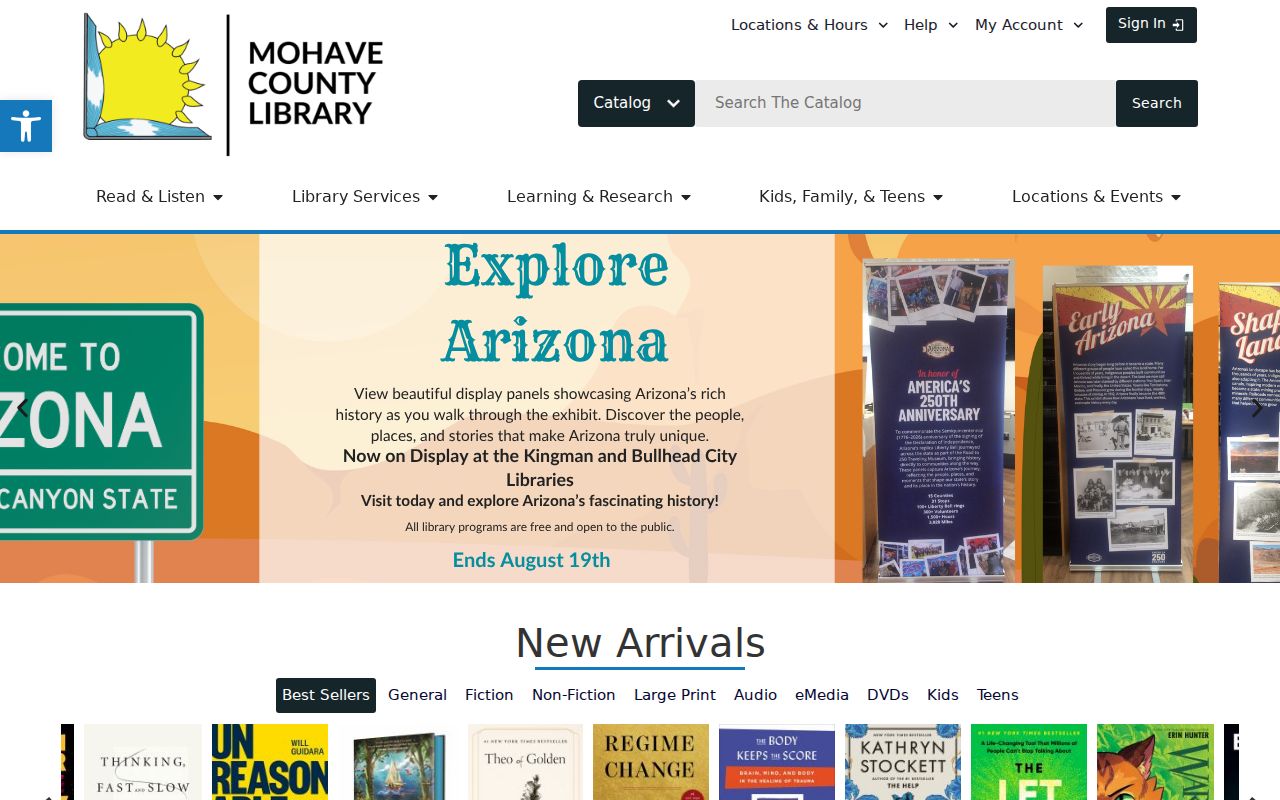
The portal is a gateway to the catalog and branch help, not proof that a certain directory year is on the shelf.
Note: Ask for a staff check before traveling, because the public branch pages do not itemize local directory years.
Seasonal Lake Havasu City Directory Access
One practical detail can change a research trip. LHGS advertises in-library Ancestry, Newspapers.com, and Fold3 from October through May, and the library closes from Memorial Day through September. It also closes Thanksgiving week and the last two weeks of December. That seasonal calendar is a strong reason to call (928) 490-1593 or seek an appointment before building a directory search around those databases.
This access pattern matters most when a printed entry must be checked against a news item, military clue, cemetery lead, or obituary. Search title and year one at a time. Save the citation, not just a name. When the society is closed, the county library, State Library inventory, museum contacts, and online county collections form the fallback chain.
Read Lake Havasu City Directory Entries
No viewable authoritative Lake Havasu residential directory page was found for direct inspection. That means the fields below are an inspection checklist, not a claim about every local volume. Start with the title page and abbreviation key. Then transcribe only what the entry actually says. A phone book may list much less than a full directory, while a reverse section may order entries by address.
| Person and name order | Copy the full form, initials, suffix, and any cross-reference exactly. |
|---|---|
| Other named people | Record a spouse or householder only if the edition identifies one. |
| Street or phone | Preserve number, directional suffix, spelling, and any exchange shown. |
| Status marks | Consult the key before reading a symbol as ownership or another status. |
| Source citation | Save title, publisher, edition year, page, column, and repository. |
- Criss-cross directory
- A directory arranged by street address or phone number rather than only by surname.
- Householder index
- A list organized around the named person associated with a home, when the publisher included one.
- Abbreviation key
- The edition's own guide to shortened words and symbols. Read it before decoding an entry.
An absence is not a firm event date. A person may have moved, died, used another name form, been omitted, or chosen not to list a phone. Compare the editions on each side of the gap, then test the clue in deeds, permits, newspapers, probate, or an obituary lookup.
Lake Havasu City Directory Trail
The historical trail has a sharp local starting point. Lake Havasu was marketed and founded in the 1960s, then incorporated in 1978. The Library of Congress catalogs the Lake Havasu City Herald from 1964 through 1994. Ads, public notices, obituaries, business items, and address mentions can fill the space between printed directory editions. The catalog record confirms the run's existence, but it does not promise that every issue is freely digitized.
This is why Lake Havasu historical directories should not be treated like the shelf of an old eastern city with a long annual run. Early resident evidence is split among county land records, development material, telephone books, newspapers, and later municipal files. The research task is to join these sources while keeping each citation distinct.
| 1958 | Robert McCulloch purchased the first 3,353 acres tied to the planned community. |
|---|---|
| 1963–1964 | The district and planned community era began. |
| 1964 | The cataloged Herald resident trail begins. |
| 1978 | Municipal incorporation created a city-record layer. |
Pre-City Mohave Resident Registers
The Mohave County great registers cover 1876 through 1920. They predate Lake Havasu City, yet they are useful when a family line reaches elsewhere in Mohave County. Searches can use first and last names, birthplace, birth year, and more options. Entries may give age, birthplace, local residence, naturalization date and place, and registration date.
Those fields can be richer than a bare phone listing. They should not be recast as Lake Havasu City entries. The great registers belong to the older county layer, while Lake Havasu's own archive begins abruptly in the planned-city era. That contrast is a useful clue: some local newcomers must be traced back to a prior state or county rather than pushed into territorial Mohave sources without evidence.
Note: A countywide great-register match needs place and date checks before it can be linked to a later Lake Havasu resident.
Lake Havasu Museum Archive Clues
The Lake Havasu Museum, 320 London Bridge Road, preserves local material and accepts archive questions at collections@havasumuseum.com. Its regularly updated digital archive is limited to Historian and Havasu Society members. Public museum hours are Tuesday through Saturday, 11 a.m. to 3 p.m., with donation admission. Contact staff before assuming that a named person, directory edition, photo, or oral history can be retrieved.
The Mohave Museum research facility in Kingman offers an appointment-only county archive with documents, manuscripts, maps, and photographs. Its site does not publish local directory year runs or research fees. These two archives complement rather than replace a verified Lake Havasu directory edition.
The museum's member-access surface can be previewed through the Lake Havasu Museum archive page.
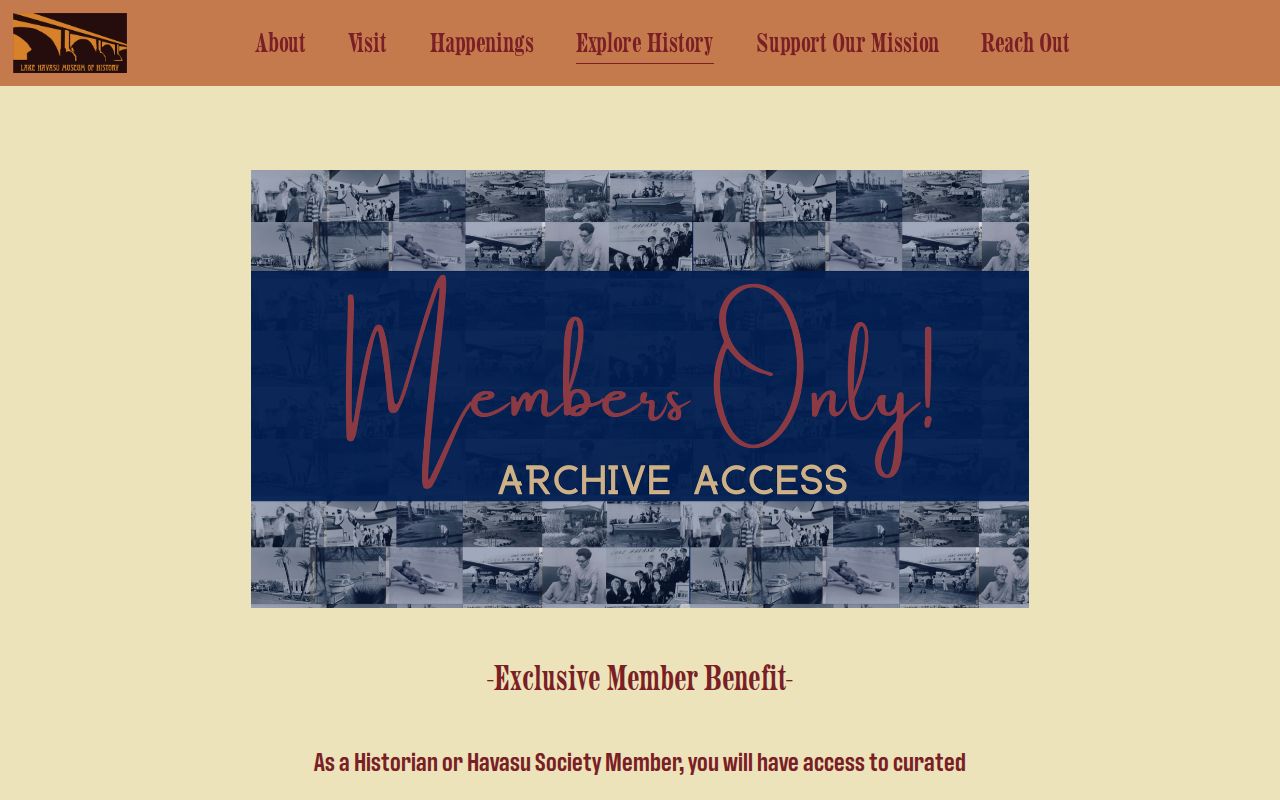
The screenshot reinforces the access rule: archive availability and membership do not establish a public, complete name index.
Trace Lake Havasu Family Records
A good family trail begins with the narrowest known fact, then moves one edition at a time. Since the open federal census ends at 1950 and Lake Havasu City did not yet exist as a named community, census work often follows a local newcomer backward to a former home. The National Archives explains the 72-year census access rule; the 1960 schedules will open in 2032.
- Start with the full name, likely date, and last known Lake Havasu address. Search variant initials and surnames.
- Confirm the volume's title, edition, publisher, key, and alphabetical entry. Check a reverse section only if one exists.
- Compare the adjacent available editions. Record the first and last observed appearance without calling either a move date.
- Pair the trail with the Herald, deeds, probate, cemetery clues, or LHGS obituary help.
- Use the 1950 census in the prior community when the evidence points to an early Lake Havasu newcomer.
A historical directory entry is a lead, not proof of identity or continuous residence. Match at least two keys, such as a name plus address, relative, age, or dated event. When the goal shifts to present-day confirmation, the Lake Havasu City resident lookup keeps modern records separate from the historical shelf.